

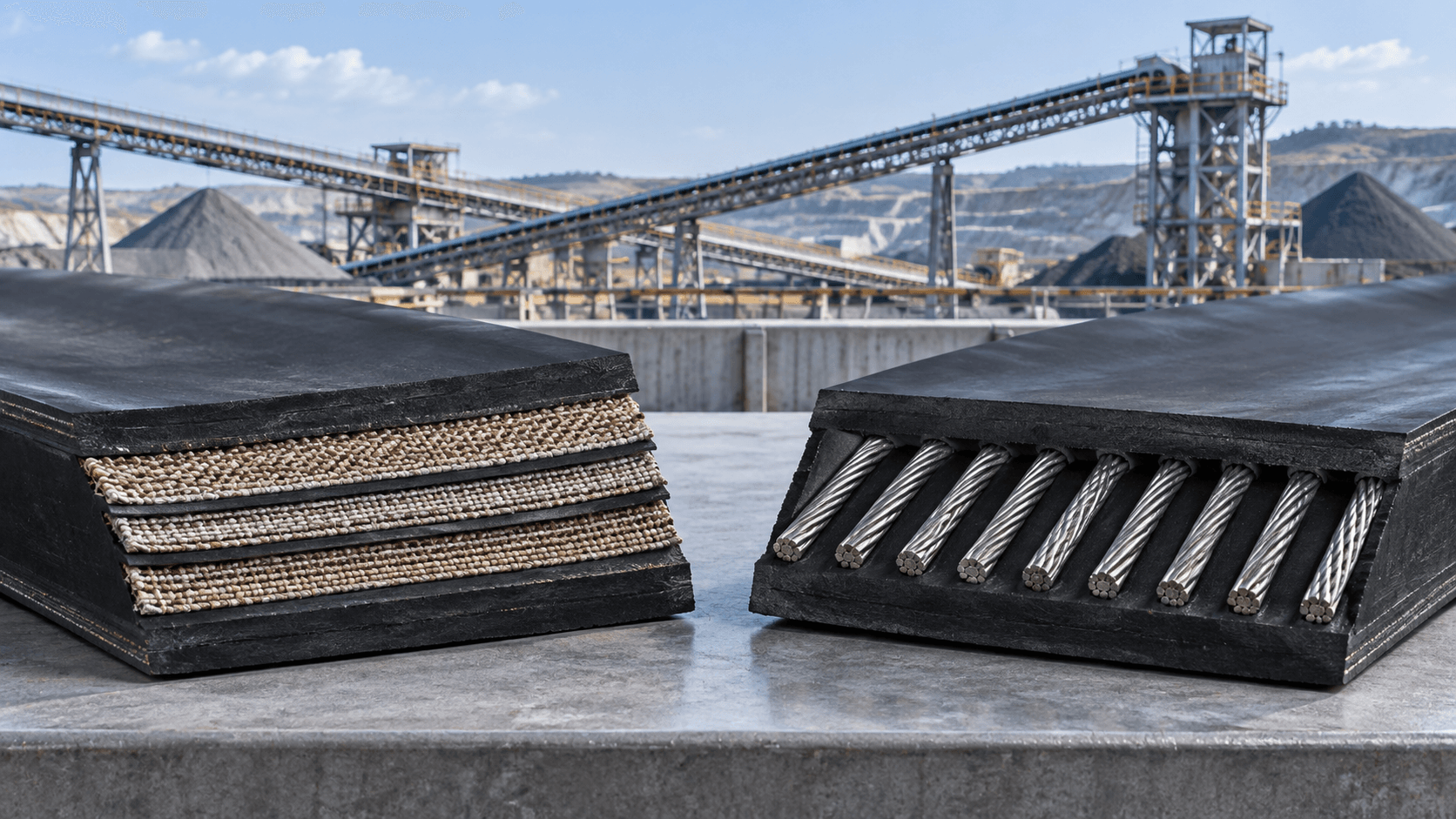
Choosing between a fabric vs steel cord conveyor belt is not simply a question of which construction is stronger. The correct choice depends on conveyor length, calculated belt tension, material load, lift, impact conditions, take-up travel, pulley geometry, splice capability and the operating environment.
A fabric belt is often a practical and flexible solution for general mining, quarry, cement and bulk material handling. A steel cord belt is generally considered when the conveyor requires higher tensile capacity, lower elongation or reliable operation over long distances. Final belt construction should always be confirmed against the actual conveyor duty.
Quick Answer: Fabric or Steel Cord?
- Choose a fabric conveyor belt when flexibility, impact resistance, easier handling and a cost-effective general-duty construction are important.
- Consider a steel cord conveyor belt when the system has high operating tension, long conveying distance, heavy load or limited allowable elongation.
- Do not select by belt width or price alone. The conveyor layout and calculated duty determine the appropriate belt type and strength.
What Is a Fabric Conveyor Belt?
A fabric conveyor belt uses multiple textile plies as the load-carrying carcass. Common reinforcement options include EP polyester/nylon and NN nylon fabric. Rubber skim layers bond the plies together, while the top and bottom covers protect the carcass from wear and the working environment.
Fabric construction provides useful flexibility and impact absorption, making it suitable for many medium- and heavy-duty conveyors. JM Belt fabric conveyor belts are available in widths from 300 mm to 2600 mm, with ply structure, tensile strength, cover thickness and rubber compound selected according to the project.
Typical reasons to select a fabric belt
- General mining, quarry, cement and aggregate conveying
- Systems that benefit from a flexible carcass
- Loading zones where impact absorption is important
- Projects requiring EP or NN multi-ply construction
- Conveyors where practical installation and maintenance are priorities
What Is a Steel Cord Conveyor Belt?
A steel cord conveyor belt uses longitudinal steel cords as its tension member. The cords are embedded in rubber and protected by top and bottom covers. This structure provides high tensile capacity and low elongation for demanding conveyor systems.
JM Belt steel cord conveyor belts can be configured up to ST10000 and in widths from 400 mm to 3200 mm. Cover compounds, breaker or reinforcement options, splice solutions and monitoring compatibility can be selected for mining, ports, cement plants, power stations and long-distance bulk handling.
Typical reasons to consider a steel cord belt
- Long-distance or high-lift conveying
- High calculated belt tension
- Heavy-duty and high-capacity systems
- Applications where low elongation is important
- Projects requiring high-strength belt construction and controlled splicing
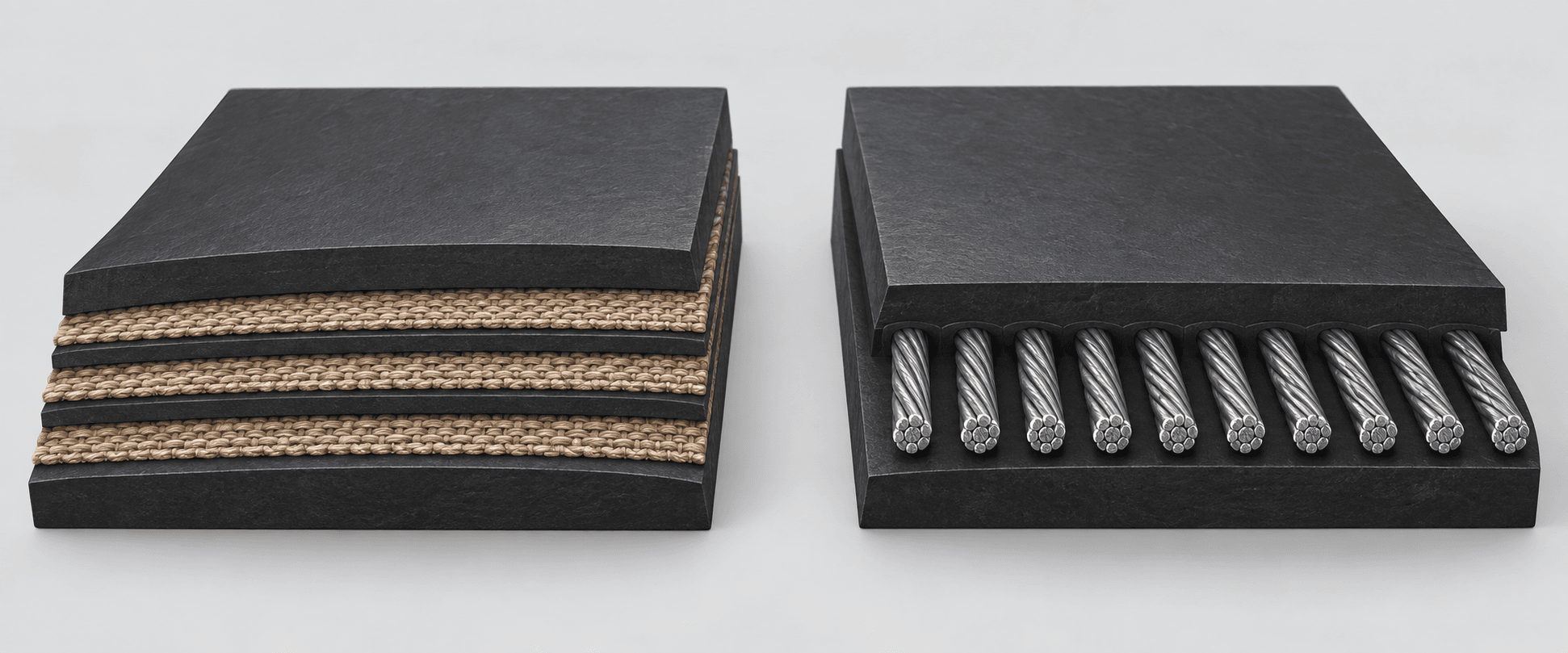
Fabric vs Steel Cord Conveyor Belt Comparison
| Selection factor | Fabric conveyor belt | Steel cord conveyor belt |
|---|---|---|
| Reinforcement | Multiple EP or NN textile plies | Longitudinal steel cords |
| Tensile capacity | Suitable for a wide range of general and heavy-duty conveyors | Suitable for high-tension and demanding conveyor systems |
| Elongation | Higher than steel cord construction and requires appropriate take-up allowance | Low elongation supports stable tension over long distances |
| Flexibility | Flexible construction for many conveyor layouts | Requires careful review of pulley diameter and bending conditions |
| Impact behavior | Multi-ply structure can provide useful impact absorption | May require additional protection where sharp or large material impacts occur |
| Splicing | Splice design must match the ply structure and duty | Precise cord preparation, alignment and vulcanized splice control are essential |
| Typical use | Mining, quarry, cement, aggregate and general bulk handling | Long-distance, high-load, high-lift and high-tension conveying |
Six Factors That Determine the Correct Belt Type
1. Conveyor length, lift and calculated tension
Longer conveyors, greater lift and higher capacity increase the required operating tension. Fabric construction can serve many short- and medium-duty systems, but steel cord construction becomes more relevant when the calculated tension or required strength exceeds the practical fabric-belt range.
2. Elongation and take-up travel
The take-up system must accommodate belt stretch while maintaining correct tension. Fabric belts generally need more take-up allowance. Steel cord belts provide lower elongation, which can be valuable on long conveyors or installations with restricted take-up travel.
3. Material size, impact and loading conditions
Sharp ore, large lumps and uncontrolled loading can damage any belt. Review drop height, impact energy, loading alignment and the need for breaker or additional reinforcement. Belt construction should be combined with suitable loading-zone support and impact control.
4. Pulley diameter and conveyor geometry
The belt must bend around the installed pulleys without excessive stress. Steel cord belts generally require more careful matching of belt construction, cord diameter and pulley geometry. Existing conveyors should be checked before changing from fabric to steel cord construction.
5. Splicing and maintenance capability
A reliable belt depends on a correctly designed and executed splice. Fabric and steel cord belts use different splice procedures, materials and quality controls. Consider the available installation team, shutdown window, inspection method and future repair capability before finalizing the belt.
6. Cover grade and operating environment
The carcass type does not replace the need for the correct rubber cover. Abrasion, heat, oil, chemicals, cold weather, fire-safety requirements and outdoor exposure must all be reviewed. JM Belt offers different cover compounds and manufactures according to applicable DIN, ISO, GB and AS requirements.
Which Belt Is Better for Mining and Bulk Handling?
Neither construction is automatically better for every project. A fabric belt may be the better choice for a quarry transfer conveyor with moderate tension, frequent impact and practical maintenance requirements. A steel cord belt may be more suitable for a long overland mining conveyor carrying high tonnage under sustained tension.
The decision should follow an engineering review rather than a simple product preference. If the application involves steep-angle conveying, also compare our Chevron Conveyor Belt and Sidewall Conveyor Belt solutions.
Information Needed for Conveyor Belt Selection
To recommend an appropriate construction, a supplier needs more than the requested width and length. Prepare the following project information:
- Conveyed material, lump size, density and temperature
- Required capacity and belt speed
- Conveyor center distance, lift and inclination
- Existing belt width, construction, strength and cover thickness
- Drive arrangement, pulley diameters and take-up type
- Loading-zone impact and operating hours
- Environmental conditions and required cover properties
- Applicable standard, inspection and documentation requirements
Browse the complete JM Belt conveyor belt range, or send these details to our engineering team for a project-specific recommendation.
Frequently Asked Questions
Is a steel cord conveyor belt always stronger than a fabric belt?
Steel cord construction is available for very high tensile requirements, but strength alone does not determine suitability. Impact conditions, pulley geometry, splice quality, take-up design and maintenance capability must also be considered.
Can a fabric belt be used in mining?
Yes. Fabric conveyor belts are widely used in mining, quarrying, cement and aggregate applications. The correct ply structure, tensile strength, cover grade and belt dimensions depend on the actual conveyor duty.
When should an existing conveyor change to steel cord?
A change may be considered when the system requires higher tension capacity, lower elongation or improved suitability for a long-distance duty. The pulleys, take-up, drive, loading zone and splice plan must be reviewed before conversion.
Can cover compounds be customized for both constructions?
Yes. Depending on the project, fabric and steel cord belts can be produced with abrasion-resistant, heat-resistant, oil-resistant, flame-retardant, cold-resistant or chemical-resistant cover options.
Request a Project-Specific Belt Recommendation
Hebei Juming Heavy Industry Co., Ltd. manufactures custom fabric and steel cord conveyor belts for mining, quarry, cement, ports and bulk material handling projects. With belt widths, strengths, cover compounds and reinforcement options configured around the application, JM Belt helps buyers select a practical construction for their operating conditions.